Barangay Certificate Requirements in the Philippines 2026
A barangay certificate is one of the most commonly requested documents in the Philippines, and understanding the requirements to obtain it is important. It serves as proof of residency, identity, or a specific status within a barangay and is often needed for employment, school enrollment, government transactions, business applications, and other legal purposes.
If you are planning to apply, understanding the basic barangay certificate requirement can help you avoid delays and multiple trips to the barangay hall. While procedures and document requests may vary slightly from one barangay to another, most local offices follow similar guidelines nationwide.
In this guide, you will learn the usual requirements, application process, fees, processing times, and important tips to help you secure a barangay certificate quickly and smoothly.
What Is a Barangay Certificate?
A barangay certificate is an official document issued by the local barangay office to confirm specific information about a resident. It serves as proof of identity, residency, good standing, or other details requested by government offices, schools, employers, and private institutions.
Many people need this document when applying for jobs, opening bank accounts, enrolling in school, or processing government transactions. Because requirements vary by purpose, it is important to understand the specific barangay certificate requirement before visiting the barangay hall.
A barangay certificate is commonly used for:
- Proof of residency or address
- Job applications and employment requirements
- School enrollment and scholarship applications
- Government benefit and assistance programs
- Bank account opening and financial transactions
- Business permit and license applications
The certificate is usually signed by authorized barangay officials and carries the official barangay seal. Since it is recognized by many institutions, keeping an updated certificate can help make important transactions faster and easier.
Common Types of Barangay Certificates
Different certificates are issued depending on the purpose of the request. Understanding the correct document helps you meet the necessary barangay certificate requirement.
- Barangay Residency Certificate – Confirms that a person lives within the barangay.
- Barangay Clearance – Certifies that the resident has no known issues or violations in the community.
- Certificate of Indigency – Issued to individuals or families seeking financial assistance, medical aid, or educational support.
- Certificate of Good Moral Character – Often requested by schools, employers, or organizations.
- Business Clearance Certificate – Required when applying for or renewing certain business permits.
- First-Time Job Seeker Certificate – Supports qualified applicants who want to access government fee exemptions.
Barangay Certificate Requirement in the Philippines
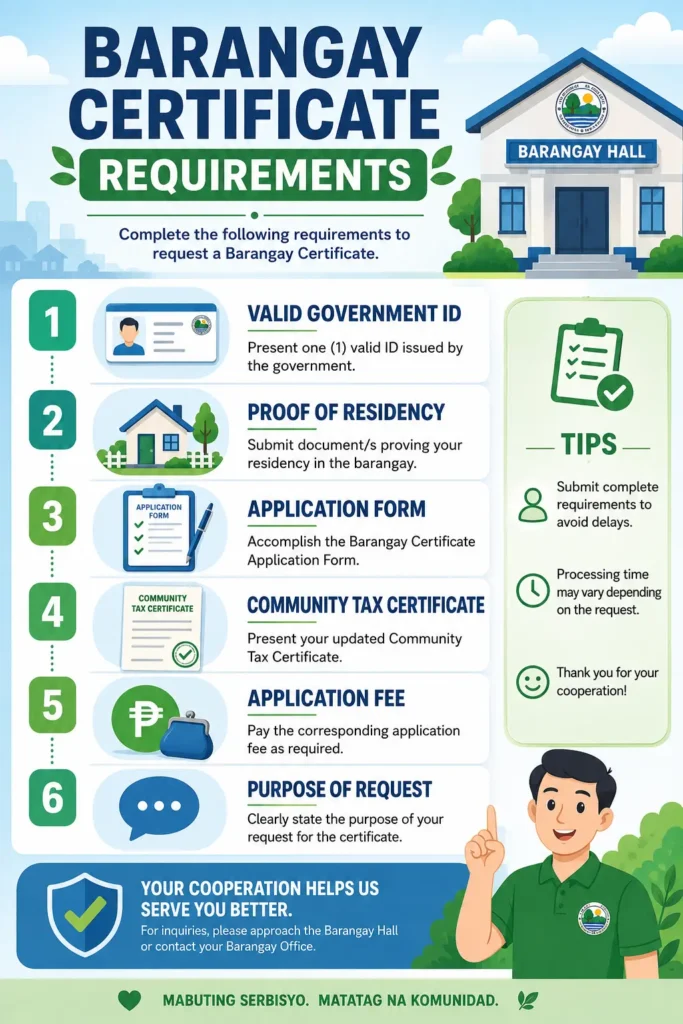
Getting a barangay certificate is usually simple, but preparing the right documents can save you time and prevent delays. While requirements may vary slightly between barangays, most offices ask for proof of identity and proof that you live within their area. Understanding the standard barangay certificate requirement helps applicants complete the process smoothly.
The table below shows the documents and information commonly requested:
| Requirement | Purpose |
|---|---|
| Valid government-issued ID | Confirms your identity |
| Proof of residency | Verifies that you live within the barangay |
| Personal information form | Records your details in barangay records |
| Community Tax Certificate (if required) | Additional supporting document in some barangays |
| Application fee (if applicable) | Covers administrative processing |
| Purpose of request | Identifies why the certificate is needed |
Most barangays also ask applicants to provide basic information such as their full name, address, date of birth, and reason for requesting the document. In some cases, officials may verify your residency through existing barangay records before issuing the certificate.
The exact barangay certificate requirement may differ depending on whether the certificate is for employment, school enrollment, business registration, or other official transactions. It is always a good idea to contact your barangay office beforehand to confirm the latest requirements.
If you are applying for a specific purpose, check the corresponding requirements early to avoid making multiple visits. Knowing the complete barangay certificate requirement can make the application process faster and more convenient.
Valid IDs Accepted by Most Barangays
A valid ID is one of the most common documents requested during the application process. It helps barangay officials confirm your identity before issuing the certificate.
Commonly accepted IDs include:
- Philippine passport
- Driver’s license
- UMID card
- PhilSys National ID
- Voter’s ID (where accepted)
- Postal ID
- Senior Citizen ID
- Student ID for students
- Company or employee ID with supporting documents
Some barangays may also accept secondary identification if you do not have a primary government-issued ID. Since ID policies can vary, it is best to verify the local barangay certificate requirement before visiting the barangay hall.
Proof of Residency Requirements
Barangay certificates are generally issued only to residents of the barangay. Because of this, applicants may need to show proof that they live within the area.
Examples of documents that may be accepted include:
- Utility bills showing your current address
- Lease or rental agreement
- Property tax documents
- Homeowners’ association records
- Voter registration showing the barangay address
- Official correspondence addressed to your residence
For example, a tenant applying for a certificate may present a rental contract and a recent electricity bill. A homeowner may use a property-related document with the current address.
The specific barangay certificate requirement for residency verification varies by location, so checking with your barangay office beforehand can help ensure you bring the correct documents.
Who Can Apply for a Barangay Certificate?
A barangay certificate is available to individuals who need proof of residency, identity, or community standing for a specific purpose. While requirements may vary slightly by barangay, most applicants must meet the basic barangay certificate requirement of being connected to the barangay where they are applying.
The following groups can typically apply:
- Residents who live within the barangay and need proof of residence.
- Students who require documents for school enrollment, scholarships, or educational assistance.
- Employees and job seekers who need supporting documents for employment applications.
- Business owners applying for permits, licenses, or other local government requirements.
- Senior citizens, persons with disabilities, and beneficiaries of government programs who need certification for assistance applications.
- Individuals requesting certificates for specific purposes, such as travel, legal transactions, bank requirements, or other official matters.
Applicants are usually required to present a valid ID and provide information that verifies their residence or purpose for requesting the certificate. Meeting the basic barangay certificate requirement helps ensure faster processing and approval.
Special Cases for Minors and Authorized Representatives
Some applications require additional documents, especially when the certificate is requested for a minor or by someone acting on another person’s behalf.
For minors, a parent or legal guardian is generally expected to handle the application. The barangay may ask for:
- The minor’s birth certificate
- A valid ID of the parent or guardian
- Proof of residence
For authorized representatives, an authorization letter is usually required. The representative may also need to present:
- A signed authorization letter from the applicant
- A copy of the applicant’s valid ID
- Their own valid ID
Completing these extra steps helps satisfy the applicable barangay certificate requirement and allows the barangay office to verify that the request is legitimate.
How to Apply for a Barangay Certificate
Applying for a barangay certificate is usually a simple process when you have the correct documents ready. Most applicants can complete the procedure in one visit, provided they meet the barangay certificate requirement and submit accurate information. To apply for a Barangay Certificate, follow our guide on the Barangay Certificate application.
The application is in person for a Barangay Certificate. For police clearance, apply here.
Fees and Processing Time for Barangay Certificates
Getting a barangay certificate is usually quick and affordable. In many barangays, the certificate can be issued on the same day if you meet the barangay certificate requirement and submit complete documents. However, fees and processing times may vary depending on local policies.
| Service Aspect | Typical Range |
|---|---|
| Certificate Fee | Free to ₱100 |
| Processing Time | 15 minutes to 1 business day |
| Peak Period Processing | 1–3 business days |
| Additional Verification Cases | Up to several days |
Before visiting the barangay hall, make sure you have all documents needed for the barangay certificate requirement. This helps avoid repeat visits and speeds up approval.
Some barangays process requests immediately, while others may require review by barangay officials. If you need the certificate for a job application, school enrollment, or government transaction, apply a few days before your deadline to allow extra time for processing.
Factors That May Delay Processing
Most applications are processed quickly, but certain issues can cause delays.
Common reasons include:
- Missing or incomplete documents
- Incorrect personal information on application forms
- Residency details that require verification
- Unpaid local obligations, if applicable
- High numbers of applicants during busy periods
If there are questions about your records, barangay staff may ask for additional proof before issuing the certificate. To avoid delays, review every barangay certificate requirement carefully and bring original documents along with any required photocopies.
Common Reasons Why Barangay Certificate Applications Are Denied
Most applications are approved without problems, but some are delayed or denied because of missing information or eligibility issues. Knowing these common mistakes can help you avoid unnecessary trips to the barangay office.
- Incomplete application forms with missing personal details.
- Failure to submit all required documents under the barangay certificate requirement.
- Providing incorrect, outdated, or inconsistent information.
- Lack of proof of residency within the barangay.
- Applying for a certificate type that does not match the stated purpose.
- Unpaid barangay fees, if applicable in the local area.
- Records showing unresolved community complaints or residency concerns.
- Using expired identification documents.
- Submitting photocopies when original documents are required for verification.
- Applying on behalf of another person without proper authorization.
If your application is denied, ask the barangay staff for the specific reason. This makes it easier to correct the issue and submit a complete application on your next visit.
How to Resolve Application Issues
A denied application does not always mean you are ineligible. In many cases, the problem can be fixed quickly.
- Review the reason for denial provided by the barangay office.
- Check whether you have met every barangay certificate requirement.
- Submit any missing documents or updated identification.
- Correct spelling errors or inaccurate personal information.
- Bring additional proof of residency if requested.
- Settle any required fees before reapplying.
- Obtain proper authorization documents if applying for someone else.
- Confirm the correct certificate type for your intended use.
If you are unsure about the requirements, contact your barangay office before reapplying. A quick verification can save time and help prevent another delay.
Conclusion
Understanding the barangay certificate requirement can make the application process faster and less stressful. Most applicants need proof of identity, proof of residency, and other supporting documents depending on the purpose of the certificate.
Before applying, confirm your eligibility, prepare all required documents, and check the applicable fees and processing procedures. Keep in mind that requirements may differ from one barangay to another.
The best way to avoid delays is to contact your local barangay office and verify the latest barangay certificate requirement before your visit. A little preparation can help you receive your certificate quickly and without unnecessary complications.