If you’re applying for a job, applying for a scholarship, getting a license for a gun, or applying for government schemes, a police clearance certificate is required for these services.
It’s a simple proof on paper that you have no criminal record and are eligible for the services required police clearance. Thousands of Filipinos apply for the clearance certificate every week, but in reality, many of the applications get rejected and delayed. This is not because they have a criminal record; it is because of the small mistakes applicants make. A few of the common mistakes are bringing photocopies instead of original IDs, wearing improper attire, forgetting the payment reference number, and missing the schedule.
To provide faster services and reduce the crowd at the police station. While the process is online, there are still limitations to the system; you cannot just apply and download your clearance certificate through the NPSC website from your home. You will need to schedule the appointment, pay for the processing fee, and physically attend your appointment for biometric and photo capture. As the document is crucial for persons’ proof of good conduct, these necessary verifications are conducted at the police station to ensure the authenticity of the document.
What is a Police Clearance Certificate?
A police clearance certificate is a document issued by the Philippine National Police. The document is issued after checking the centralised database shared by all the police stations in the Philippines. This confirms that the person is clear from all the police stations across the nation, not just locally, and doesn’t have any police complaints.
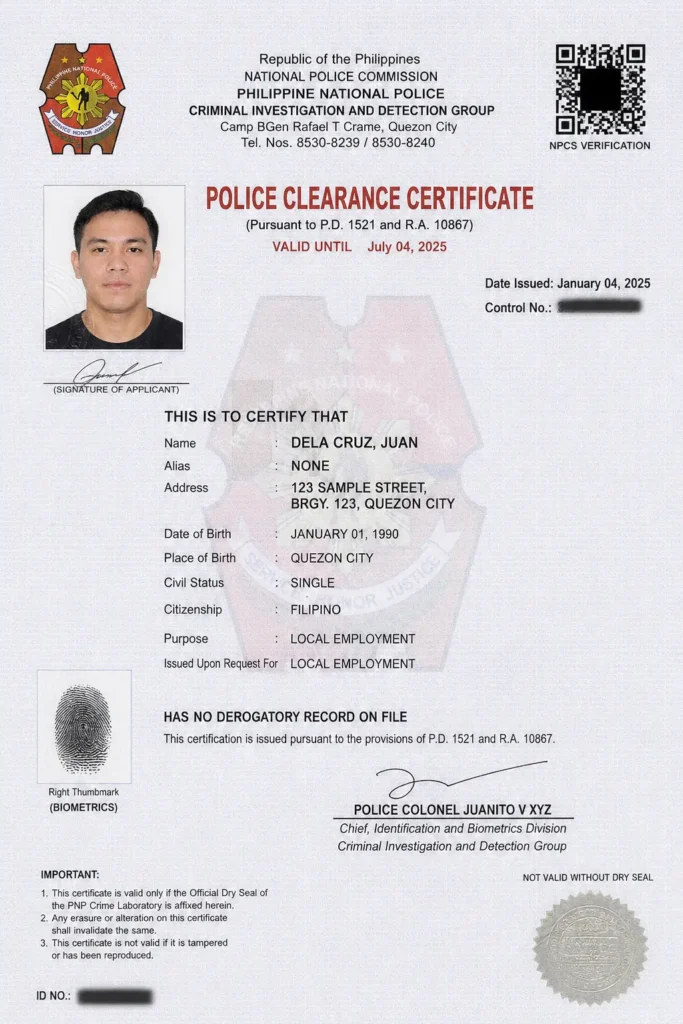
Once all the checks have been completed, a clearance certificate is issued to you. The document contains your Photo, Fingerprint data, Digital signature, and QR code for verification of document authenticity.
Common Uses of Police Clearance
You’ll typically need this document for:
Employment
- BPO jobs
- Retail positions
- Corporate hiring
Government & IDs
- National ID (PhilSys)
- Postal ID
- Supporting document for other IDs
Financial Applications
- Bank account opening
- Credit card applications
Legal & Licensing
- Gun license (LTOPF)
Important: Do not confuse this with NBI Clearance. Police clearance checks for the police complaints filed against the person. NBI is the more detailed checks of the persons, including court cases, ongoing investigations, pending court cases, and any legal issues. The NBI clearance is required for a person travelling abroad or leaving the Philippines.
Step-by-Step: How to Get a Police Clearance Certificate Online
Even though the certificate is printed, the process starts online.
Step 1: Register Online
- Go to: pnpclearance.ph
- Create an account
- Fill in your personal details:
- Height
- Weight
- Parent’s names
- Upload a 2×2 photo (white background)
Step 2: Book an Appointment
- Choose a police station
- Select your preferred date and time
Tip: Morning slots are safer (less chance of system downtime).
Step 3: Pay the Fee
- Select payment method
- Generate reference number
- Pay via:
- GCash
- Landbank
- 7-Eleven
Always save or screenshot your reference number.
Step 4: Visit the Police Station
On your appointment day:
- Arrive 10–15 minutes early
- Bring:
- 2 valid IDs
- Payment reference number
At the station:
- Biometrics will be captured
- Data will be verified
Step 5: Claim Your Clearance
Two possible outcomes:
No Hit
- Printed immediately
- Process takes 15–30 minutes
With Hit
- Requires manual verification
- Return after 5–10 working days
Police Clearance Certificate Fees
Here’s the full cost breakdown:
- Clearance Fee: ₱150
- Transaction Fee: ₱10–₱30
Total: Around ₱160–₱180
Processing Time
Here is the processing time for a police clearance certificate:
- Online registration: 10 minutes
- Station processing: 15–30 minutes
- Release:
- Same day (No Hit)
- 5–10 days (With Hit)
Validity of Police Clearance
- Valid for 6 months only
- The expiry date is printed on the document.
It is NOT valid for 1 year
Dress Code for Police Clearance Certificate
Many applicants don’t realize this, but appearance matters.
Avoid:
- Slippers
- Shorts
- Sleeveless shirts
Recommended:
- Closed shoes
- Pants/jeans
- Casual or formal shirt
Author Analysis On Fake “Non Appearance” Clearance.
You will see the ads offering the “police clearance certificate online” without the physical appearance. Stay away from such scams and avoid paying them. PNP does not issue the clearance certificate without physical appearance, live biometric verification, and real-time identity verification.
The clearance certificate that scammers represent is often fake. If you want to know more about the authenticity of clearance, you can check our guide on clearance certificate verification. When your employer scans the QR code and the verification fails, you can face job rejection and legal action for falsification. So always follow the official way to get your police clearance certificate.
You can spot the fake and real clearance certificates here. Please also verify your clearance certificate before using it.
Common Mistakes to Avoid
This is where most applicants fail, not because of eligibility, but due to simple errors.
1. Bringing Photocopies Only
Always bring original IDs.
2. Forgetting Reference Number
No reference means no processing.
3. Wearing Slippers or Improper Clothes
Some stations enforce dress codes strictly.
4. Arriving Late
Missing your slot requires rescheduling. Follow our guide to reschedule your appointment.
5. Not Saving Payment Proof
Always screenshot your receipt.
Final Expert Tips For Applicants
- Always use the official NPCS website only
- Avoid fixers or agents
- Double-check your spelling (name errors can cause delays)
- Apply 1–2 weeks before your deadline
Conclusion
Getting a Police Clearance Certificate in 2026 is no longer complicated — but it is still not fully online. The process is hybrid with the online registration and physical verifications. If you follow the correct steps, you can finish everything in under 30 minutes. Following the guide above, you can avoid delays, rejections, and unnecessary stress.