Police Clearance Valid IDs List Philippines 2026
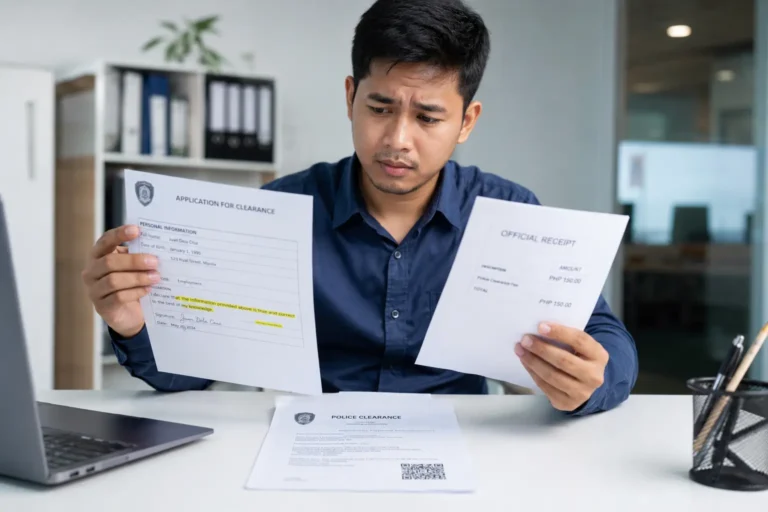
Police clearance valid IDs Philippines requirements can feel confusing, especially if you’re not sure which IDs will actually be accepted. Many applicants get delayed or rejected simply because they bring the wrong documents.
This guide gives you clear, updated answers for 2026. You’ll learn exactly which IDs are accepted, how many you need, and how to avoid common mistakes. This guide will explain to you the complete list of accepted IDs, the difference between primary and secondary IDs, minimum ID requirements, common rejection reasons, and tips to avoid delays.
What Are Valid IDs for Police Clearance in the Philippines?
Before you go for your police clearance, one small mistake can delay everything — bringing the wrong ID. Many applicants face rejection simply because their ID doesn’t meet the required standards.
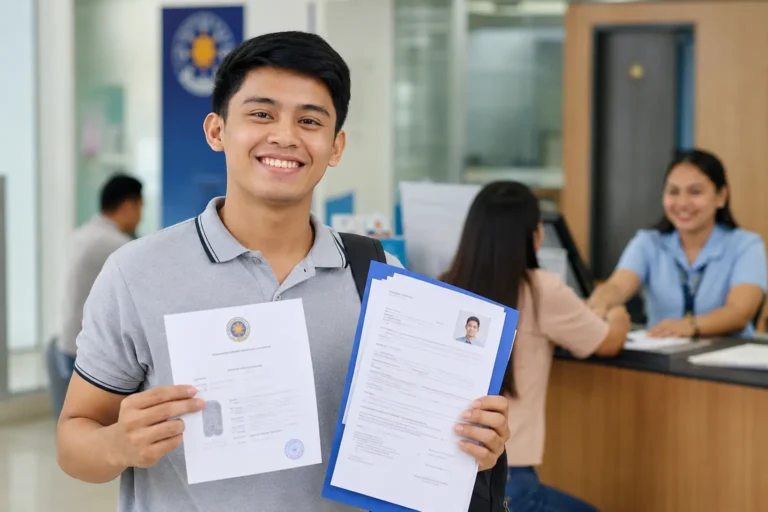
Valid IDs for police clearance in the Philippines are official documents issued by the government or recognized institutions. These IDs confirm your identity, so authorities can make sure your records match the correct person. This step helps prevent fraud, identity confusion, and processing errors.
For the valid IDs police clearance Philippines process, your ID must meet these basic conditions:
- Must be original (not a photocopy only)
- Should have a clear photo of your face
- Must include your full name and signature
- Should be valid (not expired)
- Issued by a trusted authority (government or recognized organization)
Think of it this way: if your ID cannot clearly prove who you are, it will likely be rejected.
To avoid delays, always double-check your IDs before your appointment.
List of Accepted Police Clearance Valid IDs (2026 Updated)
Getting your IDs right is one of the most important parts of your police clearance application. Many applicants get delayed simply because they bring the wrong type of ID. To avoid this, here’s a clear and updated list of accepted IDs for 2026.
Below is a simple table to help you quickly understand what is accepted and how each ID is classified:
| ID Type | Examples of Accepted IDs | Notes |
|---|---|---|
| Primary IDs | Passport, Driver’s License, UMID, PhilSys ID | Most reliable and widely accepted |
| Secondary IDs | Barangay ID, Student ID, TIN ID | Usually requires pairing with another ID |
These accepted IDs PNP follow strict verification rules. Each ID must be original, not expired, and must clearly show your photo and signature.
If you’re unsure whether your ID qualifies, it’s always safer to bring an extra valid ID. This helps prevent rejection during the verification process.
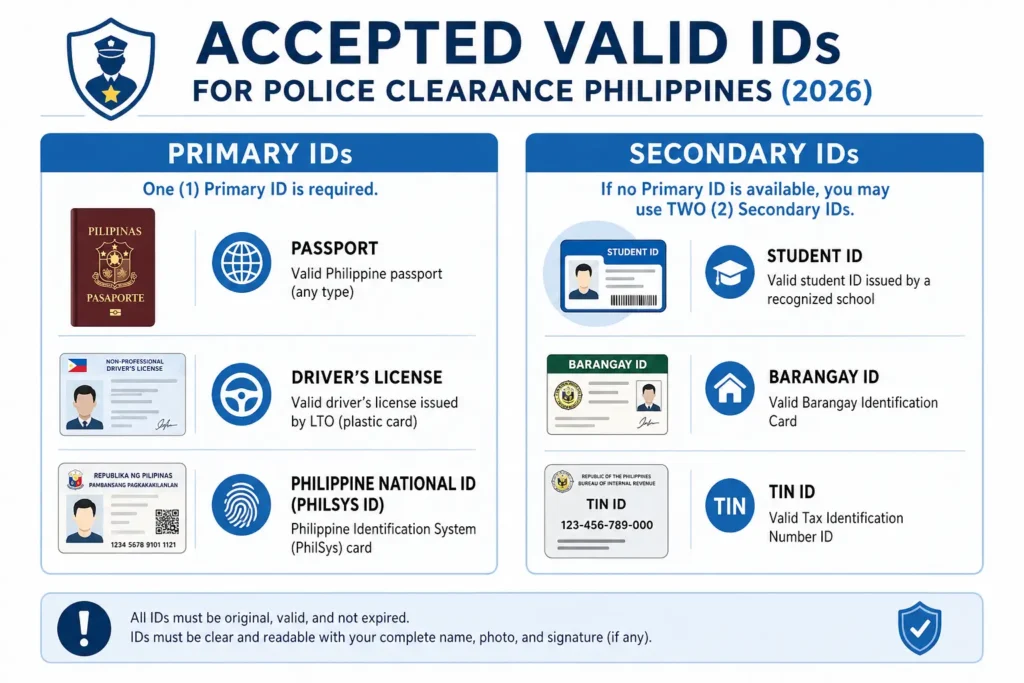
Primary Police Clearance Valid IDs
Primary IDs are the most trusted forms of identification. If you have at least one of these, your application process becomes much smoother.
Here are the commonly accepted primary ID Philippines options:
- Philippine Passport
- Driver’s License (LTO-issued)
- UMID (Unified Multi-Purpose ID)
- PhilSys National ID
- PRC ID (for licensed professionals)
- Voter’s ID (if still accepted locally)
These IDs are considered strong proof of identity because they are issued by national government agencies. They usually contain complete personal details, a clear photo, and a signature.
If you have one primary ID, you often only need to pair it with another valid ID to meet the ID requirements list.
Secondary Police Clearance Valid IDs
Don’t have a primary ID? You still have options. Secondary ID documents can help, but they are usually not accepted alone.
Here are common secondary ID options:
- Barangay ID
- Student ID (with current school validation)
- TIN ID
- Postal ID
- Company ID (must be verified)
These secondary ID types are typically used in combination. For example, you may need to present two secondary IDs together if you don’t have a primary one.
Always make sure these IDs are valid, readable, and match your personal details exactly. Even small mismatches can cause delays.
Minimum ID Requirements for Police Clearance Application
Getting your IDs right is one of the most common points where applicants get confused. Many people bring the wrong combination and end up rescheduling. Knowing the exact requirement saves time and avoids stress.
For a smooth application, you must meet the following ID rules:
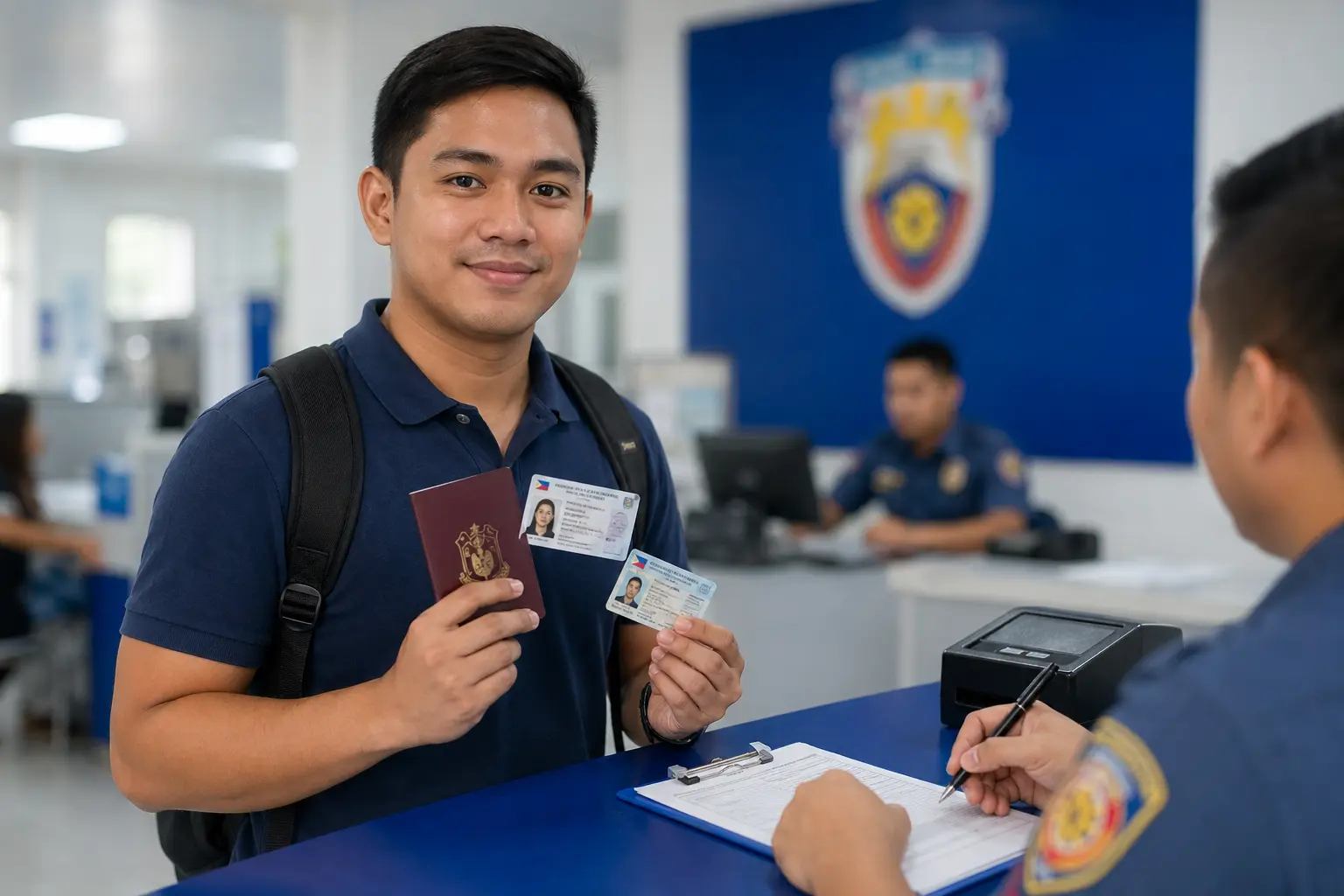
- At least two (2) valid IDs are required
- You can bring:
- 1 primary ID + 1 secondary ID, or
- 2 primary IDs (recommended for faster approval)
- Both IDs must be original (photocopies alone are not accepted)
- IDs must not be expired
- Each ID should have:
- A clear photo
- Your full name
- Your signature (if applicable)
If you only have secondary IDs, make sure they are accepted and clearly readable. In some cases, additional verification may be required.
To avoid rejection, always double-check the full ID requirements list before your appointment.
Rules and Conditions for Police Clearance Valid IDs
Before you bring your ID for police clearance processing, it is important to understand that not every ID will be accepted—even if it looks official. The Philippine National Police (PNP) follows strict rules to make sure the identity of every applicant is real and verifiable. If your ID fails any of these conditions, it may be rejected on the spot, causing delays.
These rules are not complicated, but they are very important. Most rejections happen because of simple issues like expiration or unclear details.
- Must be original, not photocopy or screenshot
Only physical, original IDs are accepted. Printed or digital copies are not allowed. - Must not be expired
Expired IDs are automatically rejected, even if they are recently expired. - Clear photo and readable details
Your face, name, and other details must be easy to read and match your appearance. - Must include signature (if applicable)
IDs without a signature may not be accepted during verification. - Must be government-issued and authentic
Fake, tampered, or unofficial IDs are strictly rejected.
Following these conditions carefully helps you avoid problems during the processing of your valid IDs police clearance Philippines requirements, and ensures a smooth verification experience.
Commonly Rejected IDs and Why They Are Not Accepted
Not all IDs are accepted during police clearance verification. Even if you bring an ID, it can still be rejected if it does not meet the required standards. This often causes delays and confusion for applicants who assume their ID is valid.
To avoid problems, it is important to know which situations usually lead to rejection:
- Expired IDs – Any ID that is past its validity date is automatically rejected, even if it is a government-issued ID.
- Unclear photo or details – If your picture, name, or signature is hard to read, the ID may not be accepted.
- Damaged or altered IDs – Torn, heavily scratched, or modified IDs raise authenticity concerns.
- Missing signature or important info – IDs without signatures or key details are often not considered valid.
- Unrecognized private IDs – Some company or membership IDs are not part of the official accepted IDs PNP list.
Always check your ID condition before your visit to avoid delays in your police clearance process.
Tips to Ensure Your IDs Are Accepted
Getting your ID rejected at the counter can delay your police clearance process and cause unnecessary stress. The good news is that most issues are avoidable if you prepare correctly before you go.
To make sure your application goes smoothly, follow these simple but important tips:
- Make sure your ID is original and not a photocopy
- Check that your ID is not expired before your appointment
- Ensure your photo is clear and matches your current appearance
- Confirm that your signature is present and visible
- Bring IDs that are government-issued and officially recognized
- Carry a backup ID in case one is not accepted
These small checks can save you time and avoid repeat visits. Keeping your documents ready in proper condition ensures faster verification under the valid IDs police clearance Philippines requirements and a smoother experience overall.
Special Cases: What If You Don’t Have a Primary ID?
Not everyone has a primary ID ready, especially first-time applicants or students. But that doesn’t mean you cannot proceed. There are still ways to meet the identification requirement using acceptable combinations.
If you don’t have a primary ID, here’s what you can do:
- Use two secondary IDs that are both valid and government-recognized
- Combine a school or company ID with another supporting government-issued document
- Check if your local branch accepts alternative combinations based on availability
- Make sure both IDs still meet the basic rules (clear photo, signature, and not expired)
In most cases, applicants rely on a mix of acceptable documents under the secondary ID category. However, acceptance may still depend on the verification officer, so it’s always better to bring as many valid IDs as possible.
If you’re unsure, prepare at least two options before visiting the station. This reduces the risk of delay and helps you complete your process without returning again.
Conclusion
Getting your police clearance is simple when your IDs are complete and valid. Most delays happen due to expired or incorrect documents, so always double-check before your visit.
When you follow the correct valid IDs police clearance Philippines requirements, the process becomes faster and hassle-free. Proper preparation saves time and helps you finish everything in one visit.